Dataflow Analysis
Dataflow analysis is a static analysis technique used to gather information about the possible set of values computed at various points in a program, aiding in optimization and error detection.
Dataflow Analysis with Monotone Frameworks
Mathematical Foundations
Semilattice (半格). Semilattice is a structure \((S, \sqcup)\), where \(S\) is a set and \(\sqcup: S \times S \to S\) is a binary operation on \(S\) that is:
- idempotent (幂等): \(x \sqcup x = x\);
- commutative (交换): \(x \sqcup y = y \sqcup x\);
- associative (结合): \(x \sqcup (y \sqcup z) = (x \sqcup y) \sqcup z\).
Bounded Semilattice (有界半格). A bounded semilattice is a semilattice that has a least element (bottom) \(\bot\) such that for all \(x \in S\), \(x \sqcup \bot = x\).
Partial Order (偏序). A partial order is a binary relation \(\sqsubseteq\) over a set \(S\) that is:
- reflexive (自反): \(x \sqsubseteq x\) for all \(x \in S\);
- transitive (传递): if \(x \sqsubseteq y\) and \(y \sqsubseteq z\), then \(x \sqsubseteq z\);
- antisymmetric (反对称): if \(x \sqsubseteq y\) and \(y \sqsubseteq x\), then \(x = y\).
Every bounded semilattice \((S, \sqcup, \bot)\) induces a partial order \(\sqsubseteq\) defined by \(x \sqsubseteq y\) if and only if \(x \sqcup y = y\).
Monotone (Increasing) Function. A function \(f: S \to S\) is monotone with respect to a partial order \(\sqsubseteq\) if for all \(x, y \in S\), \(x \sqsubseteq y\) implies \(f(x) \sqsubseteq f(y)\).
Fixed Point. A fixed point of a function \(f: S \to S\) is an element \(x \in S\) such that \(f(x) = x\).
Fixed Point Theorem. In a bounded semilattice, whose height is finite, every monotone function has a least fixed point, which can be computed as the limit of the ascending chain starting from the least element.
Proof. Let \((S, \sqcup, \bot)\) be a bounded semilattice with finite height, and let \(f: S \to S\) be a monotone function. We construct an ascending chain starting from \(\bot\): \[ x_0 = \bot, \quad x_{n+1} = f(x_n). \]
\(\bot \sqsubseteq f(\bot) \sqsubseteq f(f(\bot)) \sqsubseteq \cdots\), that is, \(x_0 \sqsubseteq x_1 \sqsubseteq x_2 \sqsubseteq \cdots\). Since the height of the semilattice is finite, this chain must stabilize at some \(x_k\) such that \(x_k = f(x_k)\). Thus, \(x_k\) is a fixed point of \(f\). Moreover, it is the least fixed point because any other fixed point \(y\) must satisfy \(\bot \sqsubseteq y\), and by monotonicity, \(x_n \sqsubseteq f^n(y) = y\) for all \(n\), leading to \(x_k \sqsubseteq y\). And thus, \(x_k\) is the least fixed point of \(f\).
Dataflow Analysis Framework
Convergence and Safety
Convergence = Termination + Confluent
Termination
Termination of Algorithm 1. Suppose \(\text{OUT}_v^i\) is the value of \(\text{OUT}_v\) after the \(i\)-th update. Now let’s prove that for each node \(v\), the sequence \(\{\text{OUT}_v^i\}\) is ascending:
- Using the induction on the number of updates.
- Base case: before any updates, \(\text{OUT}_v^0 = \bot\). After one update, we must have \(\text{OUT}_v^0 \sqsubseteq \text{OUT}_v^1\).
- Now assume after \(k\) updates, \(\{\text{OUT}_v^i\}_{i \leq k}\) is ascending for all \(v\). Let’s consider the \((k+1)\)-th update.
- Node \(v\) is not selected for update: \(\text{OUT}_v^{k+1} = \text{OUT}_v^k\). And we must have \(\text{OUT}_v^k \sqsubseteq \text{OUT}_v^{k+1}\).
- Node \(v\) is selected for update: \(\text{OUT}_v^{k+1} = f_v\left( \bigsqcup_{(u, v) \in E} \text{OUT}_u^k \right)\).
- If \(\text{OUT}_v^k = \bot\), then \(\text{OUT}_v^k \sqsubseteq \text{OUT}_v^{k+1}\).
- If \(\text{OUT}_v^k \neq \bot\), then there must be a previous update \(j < k\) such that \(\text{OUT}_v^k = f_v\left( \bigsqcup_{(u, v) \in E} \text{OUT}_u^j \right)\). By the induction hypothesis, for all \(u\) with \((u, v) \in E\), we have \(\text{OUT}_u^j \sqsubseteq \text{OUT}_u^k\). By monotonicity of \(f_v\) and \(\sqcup\), we have: \[ \text{OUT}_v^k = f_v\left( \bigsqcup_{(u, v) \in E} \text{OUT}_u^j \right) \sqsubseteq f_v\left( \bigsqcup_{(u, v) \in E} \text{OUT}_u^k \right) = \text{OUT}_v^{k+1}. \]
- Thus, in both cases, we have \(\text{OUT}_v^k \sqsubseteq \text{OUT}_v^{k+1}\).
- By induction, we conclude that for each node \(v\), the sequence \(\{\text{OUT}_v^i\}\) is ascending.
Since \((S, \sqcup, \bot)\) has finite height, the ascending sequence \(\{\text{OUT}_v^i\}\) must stabilize at some \(\text{OUT}_v^*\). Therefore, Algorithm 1 terminates.
Confluent
We define the following Round-Robin (轮询) function: \[ F(X) = \left(f_v\left( \bigsqcup_{(u, v) \in E} X(u) \right) \right)_{v \in V}, \] where \(X = (X(v))_{v \in V} \in S^{|V|}\) is a vector of dataflow values for all nodes in the CFG.
\(F\) is monotone because it is composed of monotone functions (the transfer functions \(f_v\) and the join operation \(\sqcup\)). By the Fixed Point Theorem, since \((S, \sqcup, \bot)\) has finite height, \(F\) has a least fixed point.
Now let’s prove \(F\) and Algorithm 1 compute the same fixed point → This is called Confluent. That is, no matter how we select nodes for update in Algorithm 1, we always reach the same final dataflow values.
- The main difference is that Algorithm 1 updates nodes one at a time, while \(F\) updates all nodes simultaneously.
Let \(X_i = (\text{OUT}_v^i)_{v \in V}\) be the vector of dataflow values after the \(i\)-th update. \(Y_i = F^i(\text{OUT}_{\text{entry}}, \bot, \ldots, \bot)\). And we want to prove that for all \(i\), \(X_i \sqsubseteq Y_i\).
- Using induction on \(i\).
- Base case: \(i = 0\), \(X_0 = (\text{OUT}_{\text{entry}}, \bot, \ldots, \bot) = Y_0\).
- Now assume \(X_k \sqsubseteq Y_k\) for some \(k \geq 0\). Let’s consider the \((k+1)\)-th update.
- Suppose node \(v\) is selected for update. Then: \[ \text{OUT}_v^{k+1} = f_v\left( \bigsqcup_{(u, v) \in E} \text{OUT}_u^k \right) = f_v\left( \bigsqcup_{(u, v) \in E} X_k(u) \right). \] By the induction hypothesis, for all \(u\) with \((u, v) \in E\), we have \(X_k(u) \sqsubseteq Y_k(u)\). By monotonicity of \(f_v\) and \(\sqcup\), we have: \[ \text{OUT}_v^{k+1} = f_v\left( \bigsqcup_{(u, v) \in E} X_k(u) \right) \sqsubseteq f_v\left( \bigsqcup_{(u, v) \in E} Y_k(u) \right) = Y_{k+1}(v). \]
- For nodes not selected for update, \(\text{OUT}_w^{k+1} = \text{OUT}_w^k \sqsubseteq Y_k(w) \sqsubseteq Y_{k+1}(w)\).
- Thus, in both cases, we have \(X_{k+1} \sqsubseteq Y_{k+1}\).
- By induction, we conclude that for all \(i\), \(X_i \sqsubseteq Y_i\).
Suppose Algorithm 1 terminates at iteration \(N\), then \(X_N\) is a fixed point of \(F\) (You can simply check and find \(F(X_N) = X_N\)). Since \(X_N \sqsubseteq Y_N\) for all \(N\), and \(Y_N\) converges to the least fixed point of \(F\), we conclude that \(X_N\) is the least fixed point of \(F\).
Conclusively, Algorithm 1 computes the least fixed point of the Round-Robin function \(F\).
Safety
Safety. We will state the safety property using abstract interpretation. Let \(C\) be the concrete domain of program states, and let \(\alpha: C \to S\) be the abstraction function mapping concrete states to abstract states in the semilattice \(S\). We say that the dataflow analysis is safe if for every program point \(v\) and every concrete state \(c\) reachable at \(v\), the abstract value \(\text{OUT}_v\) computed by the analysis satisfies:
\[ \alpha(c) \sqsubseteq \text{OUT}_v. \]
This means that the abstract value \(\text{OUT}_v\) over-approximates all possible concrete states at that program point, ensuring that no concrete behavior is missed by the analysis.
Since \(f_v\) are designed to be sound abstractions of the concrete semantics, and the join operation \(\sqcup\) combines information from all predecessors, the dataflow analysis framework guarantees that the computed abstract values are safe with respect to the concrete program semantics.
Examples of Dataflow Analyses
Sign Analysis
We define a lattice of signs: \[ \text{Sign} = \{ \bot, -, 0, +, \top\}. \]
Let \(\text{Var}\) be the set of variables occurring in the given program. The semilattice for sign analysis is defined as: \[ S = \text{Var} \to \text{Sign}, \]
The abstract interpretation of this lattice is as follows:
- The concrete domain \(C\) is \(\text{Var} \to \mathbb{Z}\), mapping variables to integer values.
- The abstraction function \(\alpha: C \to S\) is defined by: \[ \alpha(c)(x) = \begin{cases} - & \text{if } c(x) < 0 \\ 0 & \text{if } c(x) = 0 \\ + & \text{if } c(x) > 0 \end{cases} \]
- The concretization function \(\gamma: S \to 2^C\) is defined by: \[ \gamma(s) = \{ c \in C \mid \forall x \in \text{Var}, c(x) \text{ matches } s(x) \} \]
The transfer functions: \[ f_v(s) = \begin{cases} x := e & \text{update } s \text{ based on the sign of } e \\ ... \end{cases} \]
The join operation \(\sqcup\) is defined pointwise: \[ (s_1 \sqcup s_2)(x) = \text{join\_sign}(s_1(x), s_2(x)), \]
Reaching Definitions Analysis
For every program point, we want to determine which definitions may reach that point.
Example:
1. a = 100;     // [a -> 1]
2. if (c > 0)   // [a -> 1]
3.   a = 200;   // [a -> 3]
4.   b = a;     // [b -> 4]
5. return a;    // [a -> {1, 3}, b -> 4]
The semilattice for reaching definitions analysis is defined as: \[ S = \text{Var} \to 2^{\text{Def}}, \] which is the mapping from variables to the set of definitions that may reach that variable.
The initial value for each variable is the empty set: \[ \bot(x) = \varnothing, \] and the initial value for the entry node is also the empty set for all variables.
The join operation \(\sqcup\) is defined pointwise as the union of sets: \[ (s_1 \sqcup s_2)(x) = s_1(x) \cup s_2(x). \]
The transfer functions are defined as follows: \[ f_v(s)(x) = (s(x) - \text{KILL}_v(x)) \cup \text{GEN}_v(x), \tag{1}\]
- for an assignment statement \(x := e\) at node \(v\):
- \(\text{KILL}_v(x)\) is the set of all definitions of \(x\) in the program (since the new definition at \(v\) kills all previous definitions of \(x\)).
- \(\text{GEN}_v(x) = \{ v \}\), representing the new definition of \(x\) at node \(v\).
- for other statements, \(\text{KILL}_v(x) = \varnothing\) and \(\text{GEN}_v(x) = \varnothing\) for all variables \(x\).
Equation 1 is the standard way to define transfer functions for dataflow analysis.
Available Expressions Analysis
For every program point, we want to determine the expressions that have already been computed and whose values are still available. E.g., \(a+b\) is available at a program point if on every path from the entry to that point, \(a+b\) has been computed and neither \(a\) nor \(b\) has been modified since then.
Example:
1. a = c + (b + 10); // 1 end: {b + 10, c + (b + 10)}
2. if (a > b)        // 2 end: {b + 10, c + (b + 10), a > b}
3.   c = a + 10;     // 3 end: {b + 10, a + 10, a > b}
4. return a;         // 4 end: {b + 10, a > b}
The semilattice for available expressions analysis is \(2^\text{Expr}\), which is the set of all expressions in the program.
The initial value for each variable is the set of all expressions, and the initial value for the entry node is the empty set.
And the join operation \(\sqcup\) is defined as the intersection of sets: \[ (s_1 \sqcup s_2) = s_1 \cap s_2. \]
The transfer functions are defined as follows: \[ f_v(s) = (s - \text{KILL}_v) \cup \text{GEN}_v, \]
- for an assignment statement \(x := e\) at node \(v\):
- \(\text{KILL}_v\) is the set of all expressions that contain the variable \(x\) (since assigning to \(x\) may change the value of these expressions).
- \(\text{GEN}_v = \{ e \}\), representing the expression computed at node \(v\).
- for other statements, \(\text{KILL}_v = \varnothing\) and \(\text{GEN}_v =\) the expression computed at node \(v\).
Liveness Analysis
We want to determine, for every program point, which variables may be used in the future before being redefined.
- The semilattice: \(S = 2^{\text{Var}}\).
- Here we must revert the control flow graph (CFG) edges, so that the analysis proceeds backward from the exit to the entry.
- The initial value for each variable is the empty set, and the initial value for the exit node is also the empty set.
- The join operation \(\sqcup\) is defined as the union of sets.
- The transfer functions:
- \(\text{GEN}_v\) is the set of variables used in node \(v\).
- \(\text{KILL}_v\) is the set of variables defined (or assigned) in node \(v\).
Very Busy Expressions Analysis
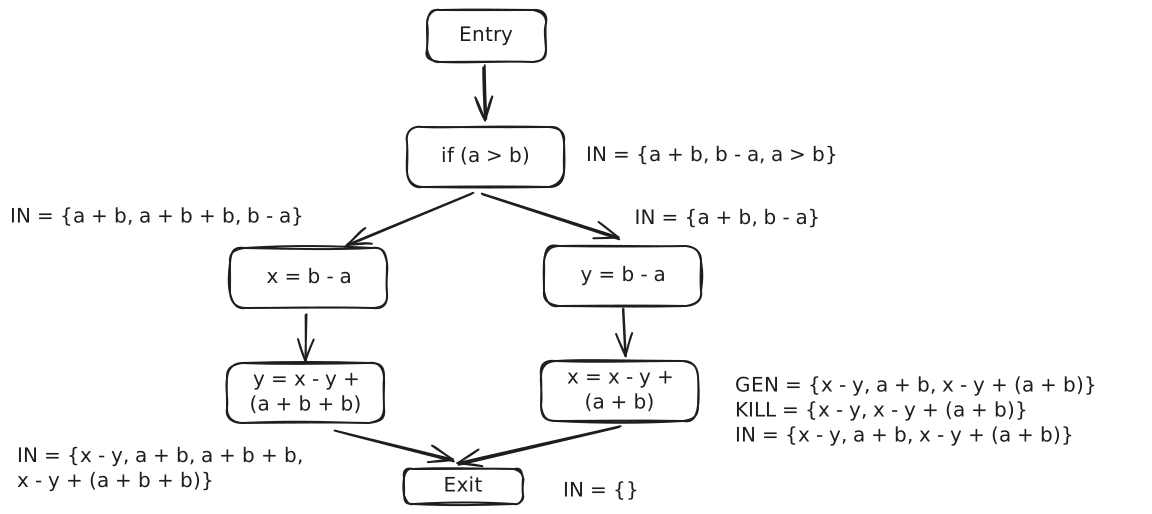
For every program point, we want to determine the expressions that will be computed on every path from that point to the exit, before any of their operands are redefined.
Example:
1. if (a > b)  // Here, {b - a, a + b, a > b} are very busy
2.   x = b - a
3.   y = x - y + (a + b + b)
4. else
5.   y = b - a
6. x = x - y + (a + b)- The semilattice: \(S = 2^{\text{Expr}}\).
- The analysis proceeds backward from the exit to the entry.
- The initial value for each variable is the emptyset, and the initial value for the exit node is also the emptyset.
- The join operation \(\sqcup\) is defined as the intersection of sets.
- The transfer functions:
- \(\text{GEN}_v\) is the set of expressions computed in node \(v\).
- \(\text{KILL}_v\) is the set of expressions that contain any variable defined (or assigned) in node \(v\).
Constant Propagation Analysis
For every program point, we want to determine the variables that have a constant value.
Example:
var x, y, z;
x = 27;
y = input;
z = 2 * x + y;
if (x < 0) { y = z - 3; } else { y = 12; }
output y;- The semilattice: \(S = \text{Var} \to (\mathbb{Z} \cup \{\bot, \top\})\). \(\bot\) represents “not a constant” and \(\top\) represents “undefined”.
- The initial value for each variable is \(\bot\), and the initial value for the entry node is also \(\bot\) for all variables.
- The join operation \(\sqcup\) is defined as follows: \[ (s_1 \sqcup s_2)(x) = \begin{cases} \bot & \text{if } s_1(x) = \bot \text{ or } s_2(x) = \bot \\ c & \text{if } s_1(x) = s_2(x) = c \in \mathbb{Z} \\ \bot & \text{if } s_1(x) \neq s_2(x) \\ s_1(x) & \text{if } s_2(x) = \top \\ s_2(x) & \text{if } s_1(x) = \top \end{cases} \]
- The transfer functions are defined based on the operations in the program, propagating constant values and updating variables accordingly.